North Staffordshire Oatcakes
If you’re searching for recipes, or referring back to one you’ve already found, its handy to have the quantities at the top of the page, so here’s my recipe for North Staffordshire Oatcackes using a sourdough starter. Please see the text below for further details.
Basic Recipe
For those that are comfortable with the bread-related maths, the basic recipe is:
M g of starter
150g oats
100-(M/2)g of wholemeal flour
50g plain flour
585-(M/2)g water
1/2 tsp sugar
1/2 tsp salt
Example recipe
Here’s how that works out for 90g of starter:
90g starter
150g oats
55g wholemeal flour
50g plain flour
255g water (for finely milled oats - use more of the total water now for coarser oats)
1/2 tsp sugar
-----------------
ferment overnight
-----------------
285g water (subtract whatever extra you added earlier for coarser oats)
1/2 tsp salt
To cook
- Heat a frying pan and grease it very lightly with butter or oil.
- Use a ladle to give the batter a quick stir, then ladle enough batter into the pan to just underfill it - either tilt the pan to spread the batter, or push it around with the back of the ladle.
- Cook for about a minute, or until the edges begin to lift and the middle bubbles up a little.
- Flip the oatcake over and cook for a further minute.
Details
Having fresh oatcakes around for breakfast is a Good Thing. I’m unable to buy them where I now live, so decided I should try to make my own. I had a look around for recipes and found a surprisingly large variation in the ingredients, and in the proportions of those ingredients. Some use a mixture of milk and water, others just water; some add oil or fat; some use a ratio of 1.5:1 wet to dry ingredients, while others use well over 2:1. I’ve made up my own recipe that works well with the sourdough starter that I keep for bread. The recipe is reasonably wet, as this produces thinner North Staffordshire style oatcakes, rather than the thicker Derbyshire type, and I decided to forgo the use of milk or fat in the batter, as these seem rather lavish in a staple bread replacement.
I use a 1:1 (by weight) wholemeal:water sourdough starter. 90g of this works well, but I’ve found I can use as little as 50g, adjusting the water and wholewheat weights accordingly, but it needs to be lively. If you don’t have a sourdough starter, I don’t see why the recipe shouldn’t work with dried yeast and a much shorter fermentation - just make the basic recipe and add the yeast, and leave it until you see some bubbles.
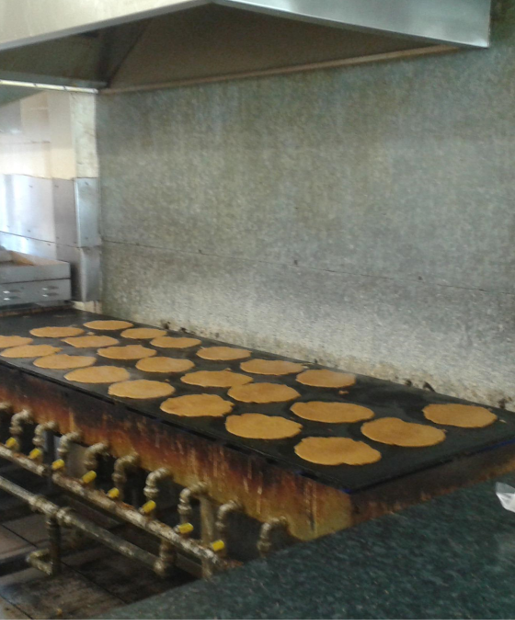
Using sourdough starter, I found that fermenting with all the liquid gave poor results. Instead, I make up the recipe with the starter, oats, flour and about half the total liquid content (a little less of the water for finely milled oats, a little more for coarse oats), then allow it to ferment overnight. In the morning, I add the remaining water and salt immediately before cooking. I’ve had the best results using a heavy cast-iron skillet, and fairly aggressive heat, which I think best emulates the big iron cooking plates commercial producers use. Depending on how thick the batter has been (which depends on the coarseness of the oats), I’ve had between 9 and 13 oatcackes from this recipe.
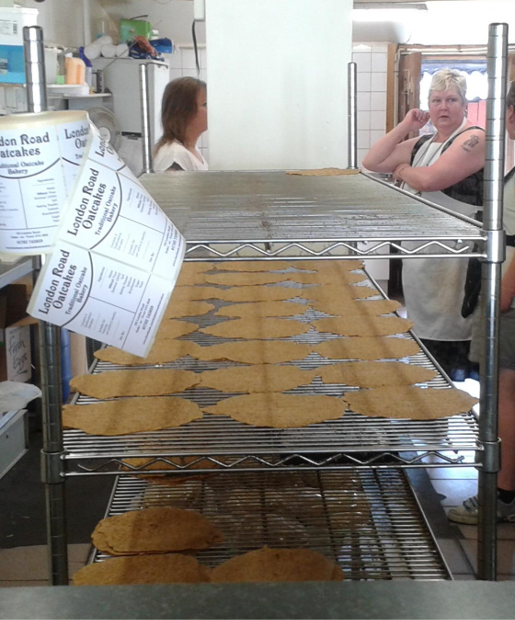
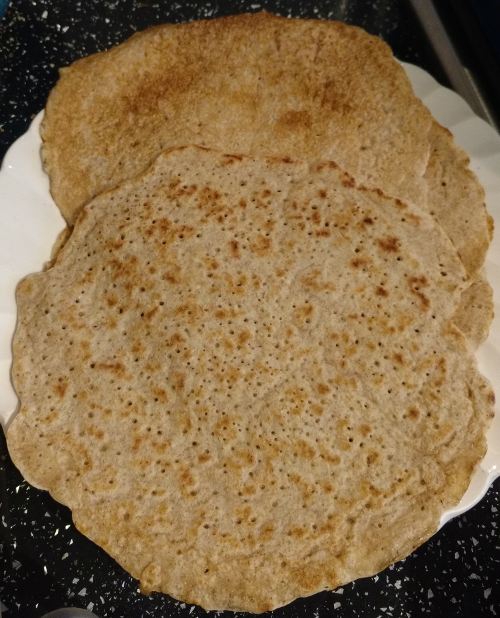
If you’re familiar with Staffordshire oatcakes, the oatcake may not be quite what you’re expecting until you’ve allowed it to cool: straight out of the pan, the side that was cooked last doesn’t look quite right, and the texture is too crisp, but this sorts itself out as the oatcake cools. I think cooling is probably an important part of the bake, as every oatcake place I’ve seen has extensive cooling racks. The first-cooked side of the oatcake should look right as soon as you flip it, though: it should be lacey, with some browning; if it isn’t, then increase the heat under the pan.