Bowed string motion
(‘Simplistic’ because it doesn’t go anywhere near Helmholtz modes.)
Someone recently asked my why, when trying to trill a high-A and open-A on their nyckelharpa, the open-A did not sound. Here is my attempt at a (reasonably) simple explanation.
Basics
A string at rest has tension along its length, but none perpendicular to its length. If you pull it sideways, the tension in the string increases. If you then let go, that tension is converted into motion: the string starts to move. It loses tension but gains speed until it overshoots its original starting position. Then it starts to lose speed and regain tension, until all the speed is converted back to tension and the string turns around, and so it continues. The string is ringing at its open frequency, or ‘fundamental mode’, and energy is stored in that mode, constantly being converted between elastic potential energy (tension) and kinetic energy (speed). (Eventually, the energy is dissipated and the string becomes still again because, in an instrument, it is gradually converted to sound.)
Modes
The fundamental mode (or ‘1st harmonic’) is the lowest frequency (i.e. pitch) that the open string can vibrate at: there are two fixed points that don’t move, ‘nodal points’ or simply ‘nodes’, one at each end of the string, and the largest motion of the string is at the midpoint between these nodes. On a violin or nyckelharpa, the nodes of the fundemental for the open string are at the nut and bridge.
The string can also vibrate at higher frequencies. One way to achieve this is to stop the string firmly with a finger or tangent, effectively moving one of end points and reducing its length. The reduced length of string has a higher frequency fundamental mode.
The open string can also ring at higher frequencies by vibrating in a mode that has more than two nodal points. If the string is lightly stopped close to its mid-point, the amount of energy that can be stored in its fundamental mode is limited, and so energy goes into the mode which has a node at that point. This is the ‘1st overtone’ or ‘2nd harmonic’, and is at twice the frequency of the fundamental, putting its pitch an octave above the fundamental. The 2nd overtone (or 3rd harmonic) is at three times the fundamental frequency, putting it an octave and a fifth higher. Higher harmonics can be produced by lightly stopping the string close to the nodal points for those harmonics.
An open string can vibrate in more than one mode at a time, and the resulting motion is the sum (or ‘superposition’) of that of the constituent modes. For instance, a string could ring at both its fundamental frequency and the 1st overtone. Since the 1st overtone is at twice the frequency of the fundamental, for a given point on the string, the two modes would move in the same direction as each other for half the time, and in opposite directions for the other half.
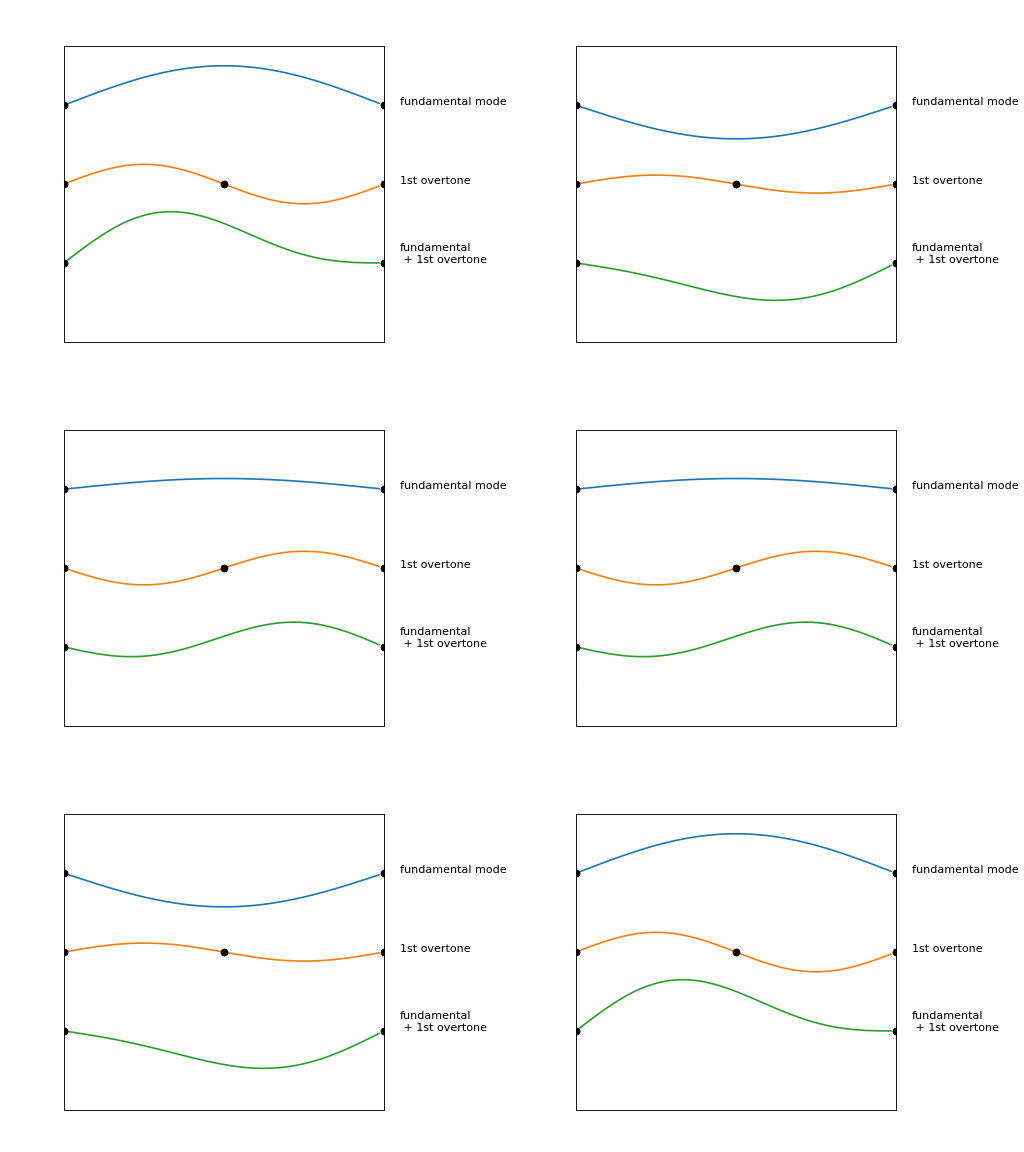
So what happens when a hard stop on a string is released? The stored energy has to go somewhere, and it is distributed between the fundamental and higher harmonics, with more efficient coupling into those harmonics closest to the stopped-string frequency. An A string stopped an octave up will continue to have some energy stored at that frequency (and continue to sound that high note briefly) when the stop is released. This can also affect the string’s response to being bowed.
Bowing
The bowing action is a slip-stick action: the bow pulls the string in the bowing direction until the tension in the string overcomes the friction between bow and string. At that point, the string snaps back, and begins to ring at its fundamental frequency as described above. When it’s speed drops to zero at the other side of its motion, the bow can grab hold of it again and help pull it along. In this way, bowing continuously tops up the energy that has been lost in producing sound (a plucked string rings down until it can no longer be heard, but a bowed string will keep sounding as long as it is bowed), and even add more energy (increasing the amplitude of the motion, and the volume of the sound produced). If the string is already vibrating at a higher harmonic, though, the energy in that harmonic can also help overcome the friction between the bow and string, when the motion of that mode opposes the direction of bowing. The slip-stick action can occur simultaneously at both the fundamental frequency and the higher harmonic’s frequency, putting energy into both modes until one becomes large enough to dominate the string’s motion. In this way, it can take some time for a bowed string to sound a clean, open-string note after playing a stopped note close to a higher harmonic of the open string.